
Be Steady with Authenticity

Authenticity is honouring what is sustainable and responsible, in the present moment.

Is not acting with haste or urgency to do or be what feels right by society or even, sometimes by yourself because is not a reaction it is conscious choice.

It can ask us to be adaptable, gentle, strong, fierce and loving.

It feels like connecting to a space within yourself, that remains peacefully centered, to have the humility and the power to adapt or transform, according to the needs that day, without losing connection, to self.

Understanding yourself deeply.


🕉️ Respect Your Body: Listening to your physical limits – observe without judgment.
🕉️ Presence: Aiming to be present in each moment. Noticing when you are not. Practicing loving kindness (ahimsa) for yourself, and others.
🕉️ Truthfulness (Satya): Being honest about your capability’s day to day, and your intentions – understanding your needs, recognising others have needs for theirs to be heard too (non-stealing).
🕉️ Inner Purpose: Considering your values and your actions and how they align. Journal, reflect and make informed and embodied choices. Connect with like-minded individuals.
🕉️ Know when to practice forgiveness and when you’ve nothing left to give. Your energy is precious (Brahmacharya). 
🕉️ Let go of what is not yours to carry (Aparigraha). Like the breath, life requires a long ‘exhale’.   Consider selfless action with regularity over intensity in balance – a middle ground. 

The practice of yoga extends off the mat, giving you the confidence to be your true self, with confidence and joy – leading to more meaningful experiences.  


Rosie Mason

Yoga, Neuroplasticity and what it all means for a yoga student

Yoga activities offer opportunity for physiological and psychological growth. They help us connect with the many dimensions of our being, which continually change. To maintain a state of balance, we must be adaptable.


It was once thought that our ability to adapt and grow mentally, was limited to youth, captured in the saying – ‘You can’t teach an old dog new tricks’. This reflects the long-held view that the brain was a fixed and non-renewable organ with a finite number of neurons that cannot be replaced.


We now know this to be inaccurate!

Our brain has an extraordinary ability to grow and reorganize, because it changes in response to experience. This is neuroplasticity – the capacity of the nervous system to make adaptive structural and functional modifications.

In the book ‘The Emotional Life of Your Brain’, Richard Davidson and Sharon Begley explore how emotions are wired to the neural circuits presenting a model based on individual ‘emotional styles’. They argue that because emotional balance is shaped by neuroplasticity individuals can intentionally cultivate greater resilience, more positive outlooks, and better self-awareness. In this book Davidson defines six emotional styles in their book that shape an individual’s personality: Resilience, outlook, social intuition, self-awareness, sensitivity to context, and attention. Resilience – Outlook – Social intuition – Self-awareness – Sensitivity – Attention.

And Yoga?

There is growing evidence that demonstrate focusing our attention can alter neural pathways overthrowing the older notion of a fixed, immutable adult brain, enforcing as Begley notes ‘The brain changes with attention.’

A 2020 study by Kajimura, Masuda, Lau & Marayama showed that focused attention mediation changes the boundary and configuration of functional networks in the brain.


Yoga, meditation, mindfulness and interoceptive awareness activate, strengthen and re-shape neural circuits. Breath-work activates both brain hemispheres and influences neurophysiology by relaxing mental states while activating muscle groups. These activities build new emotional associations and behavioral patterns, while enhancing memory, focus and cognitive stability.

We know that stress imposes harm to the brain, can impair learning and can lead to neurological inflammation, which is associated with neurodegenerative diseases.

Yoga supports neuroprotection (the process of shielding nerve cells, neurons, from damage, dysfunction, or death), by reducing cortisol, increasing vagal tone and promoting neurogenesis, increasing ‘gray matter volume’, this is associated with a thicker cerebral cortex, directly affecting memory function, cognitive clarity and interoception, body awareness! It’s a lot.
Pranayama, our breath control practices also increase alpha and theta brainwave activity linked with improved cognition. In case that wasn’t enough.


Above the brainstem, at the top of the spinal cord are the functions that controls perception, movement, and the body’s vital functions. The Thalmus and the Hypothalamus and the pituitary and the pineal glands. Yoga directly impacts these functions by enhancing the brainstems oversight and control of major bodily systems like breath, heart rate and vascular tone.

But how?

Yoga influences these areas by helping regulate sensory, emotional and hormonal pathways.
In practice positive feedback loops are strengthened, by breath awareness and effective function, interception development and asana for alignment and energetic flow, to name a few – all creating more stable feedback functions to support the effective regulation of stress and reducing sympathetic overdrive.

When faced with major change, the healthy brain can re-wire and re-model connections especially in the cerebellum and the prefrontal cortex. The adaptability demonstrates yoga’s significant role in supporting emotional regulation, cognitive growth, and overall well-being.

Rosie Mason

Embodiment & Mindful Living

We refer to embodiment a lot in the wellness world.  
Put simply – feeling into our physical body. 

Why, is it an integral part of developing a good yoga practice and mindful lifestyle?

The origin of the word comes from, ‘giving bodily form to something abstract.’  For example, an individual can embody kindness, or bravery. 

The mind-body science

In more contemporary usage, fields of psychology and yoga the term invites a sense of attuning awareness and even, holding purposeful intention.   It’s become a practice of living into something consciously through the physical body.

Cognition is rooted in movement – the body and its movements are integral to thought, rather than separate from it, this is ‘embodied cognition’. Operations we perform such as conceptualising, reasoning and understanding – have roots in bodily behaviour, that sensation and movement are intertwined. 

Sensory motor loops are the bodies way of constantly inputting information, or of course ruminating on it! They help, or hinder us in setting the boundaries of perception regarding balance, feelings of safety and proprioception (your awareness of your body in space).    

They also effect emotional regulation, so, becomes the bodies way of processing embodiment.   You could say that they are the physiological manifestation of embodiment – the biological circuits in our body that make the integration into the mind possible. 

Some perspective

Embodiment is a lived and felt integration of the mind, body and intention, of thought or consciousness. 

A “felt unity” as Merleau-Ponty, a Frech phenomenological philosopher describes; Embodiment is neither the mind, nor the body experienced as separated from the other. The inseparability between the two forms the crux of the state of embodiment. Ponty explains that embodiment is about the way we experience the world through having a body.

Yoga

Yogas ‘embodied practices’ go some way in exploring how the body shapes experiences. 

Important in yoga is the breathwork (pranayama), and the positions (asana), which when combined in regular practice teaches experiencing a felt perception of the body in space. Pranayama and Asana are just two of the traditionally taught pillars of a yoga practice and support a regulated state of body, and mind. Pranayama involves the concious regulation of the breath as way to influence the body and cognitive state.

In yoga, the breath, is understood as a vital form of energy cultivated through taught pranayama (breathwork practices).
The most well known energy worked with in pranayama is ‘prana’, created through the process of pranayama (breathwork practices).  

Through a rhythmic awareness of breath we can perceive how physical patterns mirror mental states, and can tap into the interdependence of body, energy (prana) and consciousness (thoughts and perceptions).

It’s hard to practice embodiment when you are de-regulated, or over stimulated, but if you can get on the mat and practice a form of yoga that suits you that day, for ten minutes – you will work towards regulation and a state of embodied awareness.

The bodies responce

Conscious breathing combined with asana promote a balanced state, which means increased parasympathetic nervous system (rest and digest) activity while decreasing sympathetic ‘fight-or-flight’ responses, and down-regulating the HPA axis’s release of stress hormones like cortisol.

The HPA is a system in your body that tells your brain to release or hold back on releasing hormones, it’s an amazingly clever system, that we can help regulate.

Yoga is so much more that positions and breathwork

Yogas embodied practices help reveal – and can transform, in how the body shapes experiences.

Focus, self-reflection, discernment, inquiry, observation and compassion are all aspects of yoga, and at their core are lived, subjective experiences. When these inner capacities are experienced and practiced, in a conscious state, over time we foster a deeper, more trustworthy and lived connection, between the mind and body. They act like a bridge.


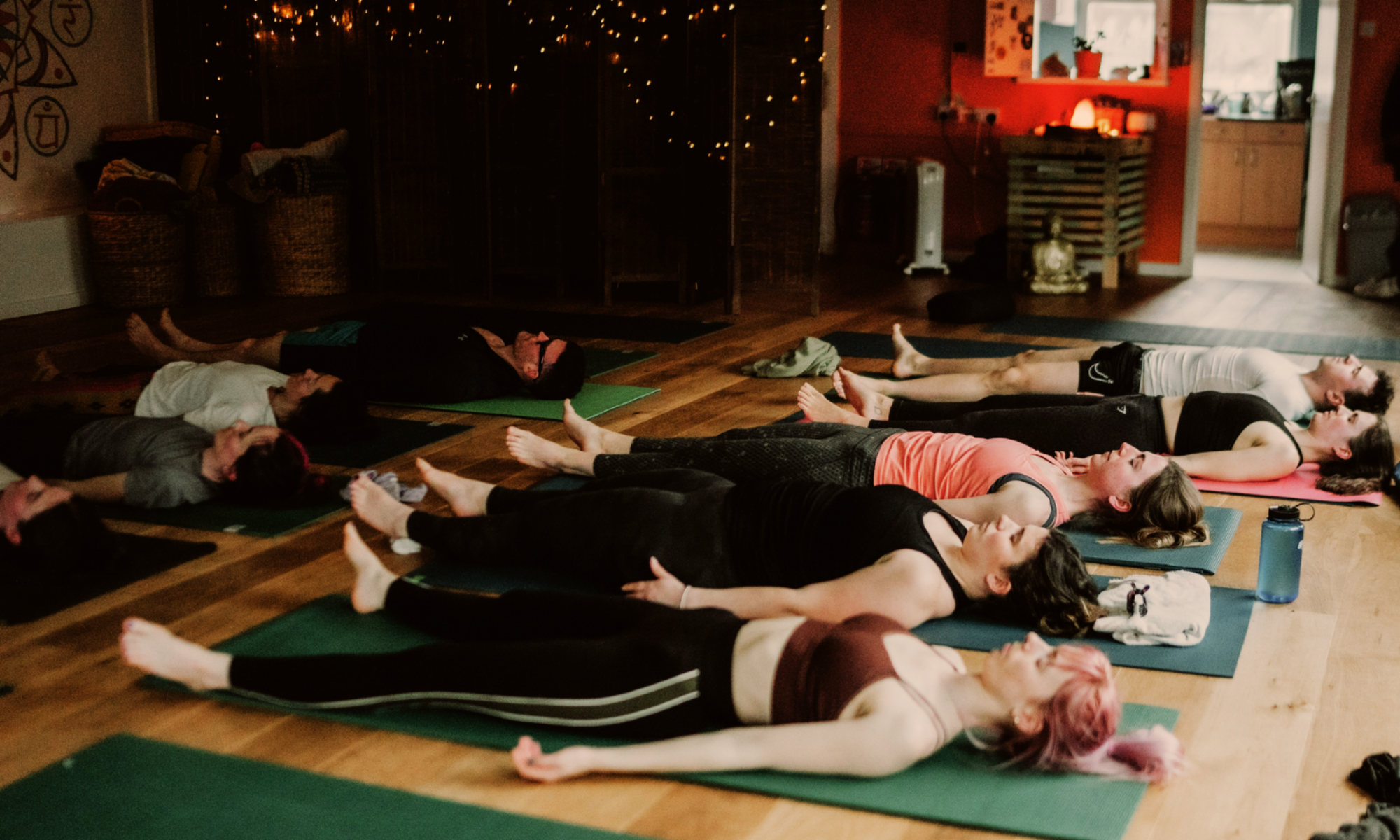
When we practice the practice of Yoga Nidra (a guided meditation practice that leads to a state of deep, conscious relaxation), you will be asked to consider a Sankalpa – a heartfelt intention.

Our Sankalpa shapes how our practice and our day and movements are lived. A Sankalpa is a vow, aligning with a higher purpose, or experience, that we aim to embody in the practice.
You could imagine it as a seed of thought, that grows within you. ‘I am whole’, ‘I live with compassion.’ It helps our unconscious tendencies, align with a conscious intention.

What yoga does so amazingly is offer a gentle framework for, not only cultivating these encouraged habits, through a commitment to an embodied practice, but provides a value-based system integrating ethical guidelines for interacting with others, and inward self-disciplines and personal observances for self-development.

In the process of maintaining an ‘embodied state’ we can, with practice, develop capacity to maintain the practice of these, positive attributes.

Knowing is not linear.  Yoga practice, and embodiment practice, is a continual commitment.

In a class in which you are taken through a mindful movement – where you focus with purposeful intent, and inquire into what you feel, or what come up – this bit is important, you remain focused, and can, not always but often, limit rumination or external distraction.

In this state of extended awareness, the parts of your brain that regulate your emotions, can and do grow in capacity – not in a superhuman way but in a way that allows it to tone and strengthen.

Yoga offers us a valuable window to view and feel a place unique to ourselves in which we are neither suppressing, nor over stimulating our system.   A place of comfort, physically and emotionally, a regulated and embodied space.

An enriching experience, that can help us tolerate things effectively both on, and off the mat!

Rosie Mason xx

Social Prescribing & Yoga

Social Prescribing is increasingly recognised as a positive approach within healthcare, now integrated into healthcare systems in over 30 countries. In the UK it formally begun in 2019.

6-years in, is it making a difference? Have you been prescribed yoga?

Studies show that social prescribing can reduce GP visits by up to 28% and lower reliance on emergency care (The King’s Fund, 2020).

The approach aims to connect individuals to non-medical and community interventions. This can be things like walking groups, community art projects, gardening initiatives, and yoga.

Their methods considers that physical, psychological, and social factors all shape well-being. Their work bridges clinical and holistic wellbeing fields.

Imagine having yoga in hospitals, schools, nursing homes and mental health wards as standard.

Imagine being prescribed yoga – will we get there in the UK?

There is no direct investment. However, social prescribing is a strong move towards a broader understanding of what holistically treating health looks like, in public health.
Maybe funding will trickle down to organisations like Shanti Bee in Newcastle, eventually.
Evidencing non-medical interventions like yoga work, is difficult.

The impact is often broad, across an individual’s life and the results are subjective, ‘improved mental well-being’ or ‘stress reduction’ are difficult to quantify and compare.

There are also such a wide range of yoga styles; more demanding practices like Ashtanga to gentler forms like Restorative or Yoga Therapy – so it’s difficult to generalize findings.
What we do know that there is no one fix, so why would we claim so.
So how do we measure the effectiveness of yoga, when we know a rounded multi-disciplinary approach is needed for sustained wellness.

How can yoga help build an equitable society?

Yoga does provide a framework for understanding the aspects of self and gives guidance in how to find balance.

At its heart yoga embraces inclusivity – making it a powerful tool for society.
We often reference the physical and mental benefits of yoga, but there is much more to discuss, understand and promote.

An ancient yogic philosophy called Panchakosha – provides an inclusive way of working with individuals. These teachings of a system called Koshas, help yoga students understand the importance of balance across five ‘dimensions’ termed as the panch koshas. The term panch means five and kosha means sheath.

A social prescriber might use a STAR system to measure the impact of support. A Yoga practitioner offering yoga therapeutically, might refer to their studies of the Koshas.
These foundational teachings of yoga impart the practice of self-awareness, spiritual knowledge, and philosophical insight, drawing upon the teachings of ancient sacred Hindu texts.

While some institutions have made steps towards integrating yoga, with positive results, progress is slow, and many people cannot easily access the services they need to thrive.
Holistic education is not mainstream enough to encourage the ancient practices that could help people prosper and be as well as they possibly can in all their layers of self.
Sweden known for its commitment to accessibility and inclusion for people with disabilities has integrated yoga into its health services since 2010.

The Canadian Agency for Drugs and Technologies in Health has advocated for its use in treating PTSD, anxiety, and addiction. Australia is also noted for its forward-thinking approach to yoga in healthcare.

What does yoga do for you?

Yoga provides us with improved mobility, pain management, flexibility and helps tone and strengthen major internal organs and nerves. It benefits the musculoskeletal, respiratory, digestive, cardiovascular and the endocrine system!

Yoga directly tones and strengthens our vagus nerve, part of the nervous system, supporting emotional resilience. This nerve supports essential involuntary functions like heart rate, breathing, and digestion, helping to calm the body playing a significant role in social interactions.

Yoga supports self-regulation. Practices like mindful breathing, focused postures, and meditation enhances emotional awareness, helping us to reduce the stress response many of us are faced with daily.

The practices help us foster a stronger sense of self-worth, confidence and connection. A welcoming and non-judgmental space in a regular yoga class helps us connect to a greater awareness of inclusivity and belonging.


Practically, yoga doesn’t just help the mind, the body, our energy levels, but it taps into our internal wisdom.

Shanti Bee supports the work of Link Workers in our community.

On May 9th we are hosting a connection day, for Link workers and health professionals in Newcastle, to discuss the effectiveness of group-based activities, patterns that may hinder self-care or reinforce isolation to inform our own practices and ways of working.

Shanti Bee provides essential holistic health services to promote healing and management of health conditions. Activities promote preventative care, leading to improved quality of life.

We hope to support the increase of an interdisciplinary approach, social prescribing and hope for enhanced clinical understanding within yoga and yoga therapy.

Yoga Therapy – What if I’m triggered?

Understanding the environment:

Traditional yoga has many benefits, many are therapeutic.

That’s not to say all classes are a form of therapy.

Yoga is a spiritual practice.  Since its continued growth many consider it a form of exercise with some classes requiring a high level of physical skill techniques and strength.  It’s certainly not a sport, perhaps an Art form in some case. 

As more and more people self-refer into a yoga class as part of a healing journey, I consider the implications of Yoga Therapy. 

Triggers and emotive responses:

It’s not unusual to feel emotions coming up in yoga classes that you don’t usually feel, or don’t expect. 

A trigger can be described stimulus that may cause someone an emotional or physical response or worsen symptoms of mental illness. 

Techniques used in Yoga can sometimes bring up some deep emotive responses. 

I’ve cried in yoga classes. Had overwhelming emotional responses. It can come up unexpectedly and the unknown feeling can make me feel uncomfortable, especially in a room of people that I don’t really know. 

Yoga incorporates mindfulness practices and invites students to practice self-reflection. This can evoke painful feelings or memories, sometimes associated with traumatic events.

It’s very important you feel safe in these circumstances. 

Therefore, group classes are not always suitable for people in active addiction to substances or people struggling with severe mental illness, as both the practice and response to the practice can trigger a worsened mental state.

Every class is very different, many yoga teachers have a plethora of trainings and experiences bringing their own unique offering to a class or session.

If you are on a healing journey with yoga, it’s important you feel comfortable and safe in the classes you choose.  Be sure to keep reading for some guidance if you ever do feel triggered. 


Yoga Therapy:


Yoga supports our peace of mind, stress reduction and mental clarity.  On a physical level it improves our bodily functions, supports healing and the practices are proven to tone major organs, keeping us as healthy as we can be. 

The breathing techniques, we call Pranayama can reduce physiological arousal and calm the nervous system, which help manage symptoms of anxiety, hypervigilance, and hyperarousal commonly associated with trauma.

It’s accessible and a truly practice for everyone, with the correct support mechanisms in place when used for therapeutic purposes. 

Yoga Therapy as a practice, blends the ancient wisdom of yoga with modern, evidence-based practices. It’s person-centered and tailors’ interventions to needs of the individual.

Yoga as a therapy has its foundations in the Koshas framework which explains the human experience as five interconnected layers:  Physical, energetic, mental/emotionalwisdom/intuition, and spiritual/connectedness. All these aspects of self-contribute to well-being.

A trauma informed yoga class focuses on creating a supportive environment tailored to the needs of the students in the class.  In a trauma informed yoga class safety and choice is paramount.  The teacher or studio will strive to accommodate the diverse experiences and range of often complex needs of the students. Classes will be smaller in size and much slower in content. Activity will gently introduce mindfulness to promote and work towards self-awareness, alongside practices to develop resilience and promoting healing.

At Shanti Bee we are a trauma aware space. We host trauma informed classes as part of our Steady Souls program.

While we can’t promise to illuminate all triggers, as who can. We will do all we can to minimize them and hold an inclusive, safe and empowering space.

We are a supportive and inclusive community. We hold this space so that our members can practice with others who may have similar experiences supporting their healing journey. 

What if I’m triggered?

Trauma can show up in your body, during a class, or after a session. Understanding that it is a response and part of a process which you are doing to support your healing is important. 

Breathe

If you experience sensations or emotions arising in your body that feel overwhelming or distressing, or perhaps you can’t connect to how it makes you feel, pause from the practice and take several deep breaths. Taking an equal inhale and exhale is a great way of regulating, inhale for 5, exhale for 5. 

Breathing deeply can help activate the body’s relaxation response and create a sense of grounding.

Check-in 

Take a moment to check in with yourself. If you’re able to can you observe the physical sensations, emotions, or thoughts that arise without reaction. We’ve written some thoughts on the importance of checking in you can read here.

Modifications 

If certain poses or movements are triggering a physical or emotional response, can you modify your practice?  It’s nice to find movements that suit you and if you are not sure, your teacher should have a few modifications up there sleeve in case of this situation. 

Remember that you can choose to opt out any time you like and take a child’s pose, for example or simply take a break and focus on gentle movements and breathwork in a comfortable seated position, eyes can be closed or open. 
Closed eyes is nice as it removes any external stimuli. 

Self-compassion

Be gentle with yourself. We are human and we have boundaries – some which we know about and others which we find out about along the way. 

Prioritizing yourself is the best place you can be in.

Let others know

Letting the teacher know, or talking to a therapist, friend or family member about it can help. Guidance comes in all shapes and sizes. 

Checking In

Checking In: What’s that when it’s at home?

How do you check-in with yourself in a therapeutic context? Do you hold space for yourself and your mental health and what does that look and feel like?
We often ask the question of others ‘how are you?’
How often to you ask yourself and allow space and time to interpret the response.
Check-ins don’t just provide you with a chance to assess how you’re feeling, what’s weighing on you, and how your coping mechanisms are managing in the environments you are in. The process helps us improve our overall wellbeing and supports the relationships we have with others.
We know that mental and physical health are closely intertwined.

Addressing mental health concerns, with check-ins on a regular basis, as our life and the people in it changes, can lead to improvements in sleep, energy levels, and overall physical well-being.

Benefits:

• Catch symptoms before they get worse
Early intervention is often the key to effective treatment. Checking in will allow you to see any symptoms. If you journal your check ins, it will act as a great tool for seeing how much you’ve improved, or perhaps sometimes declined and noting these times can prevent it becoming unmanageable.

• Build emotional awareness
Asking ourselves how we feel about things such as events in our life or themes circulating in our community, can help us to gain insight into our emotional patterns and behaviours which leads to healthier coping strategies.

We have a term ‘Samskaras’ in yoga – this term describes the subtle impressions of our past actions, or the imprints left on the mind by past experiences. When our habitual patterns become so ingrained that they alter our body chemistry, it can be called addiction. When they become strong enough to alter our thinking process, we call it “samsara.” It’s like a deep groove in our mind patterns.

Remember though, just as habits are formed through repetition, they can also be transformed with conscious effort and awareness.

Yoga teaches us that through awareness and practice, samskaras can be shifted, helping us cultivate new, healthier responses. Checking in on a regular basis, we become increasingly aware of our own patterns, learn responses and triggers that affect us day to day.

• Build Long-Term Coping Skills
Checking in in a therapeutic context isn’t just about addressing problems; it’s about building long-term emotional resilience.
Whether you’re navigating relationships, work pressure, or on a path of personal growth, consciously checking in with yourself can go a long way in supporting wellbeing.

What does it look like?

Even when life is relatively calm, we are still processing emotions. Checking in, is always useful – as a proactive means of wellbeing and as a reactive tool for healing and transformation.

• 1:1 talking therapy is one of the best resources for checking in, providing a held, consistent space and professional space. Therapy sessions are a proactive way of understanding yourself and the world we live in and can be extremely helpful in helping us build an emotional toolkit to navigate life’s ups and downs with more ease.
Yoga classes, 1:1 holistic therapies, immersive workshops or retreat weekends can help us find clarity, focus and ‘head space’ that we need to create a suitable environment for checking in with ourselves. In classes we are often guided to observe, feel or connect to our ‘self’, while the movement and breathing exercises help us release tension held in the body.

• Mindful practice in group or 1:1 class support us in observing the coming of thoughts and emotions without becoming lost or stuck in their narratives. The practice of witnessing, without reaction creates a space for conscious response rather than reactive or learnt conditioning.

• Sound Therapy like mantra – a sacred sound, singing, gongs and bowls help break through layers of our emotions, or we could say disperses stuck energy helping us own the space again.
Chanting sacred sounds or mantras creates resonance within the mind, loosening the grip of deeply embedded imprints which helps foster a sense of inner shanti.

• Journaling is a written tool for self-reflection, and it gives us a tangible means of bringing patterns to the surface, allowing for a conscious measure, or observation.

Checking in is a great thing to make a habit with – but don’t be disheartened if you don’t have a regular practice, or if you slip out of doing it often.

It’s a very intuitive practice – tools we can pick up, when life hands us a reason too.

The hard thing of course is committing the time to it.